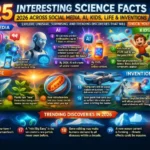

Most people think science is something dusty in a textbook, but in 2026 it literally powers how we think, scroll, eat, travel, and even sleep. You might not realize it while scrolling through TikTok or binge‑watching on YouTube, but there are facts so strange and delightful that they will change how you see everyday life.
TikTok Trending Topics 2026 – USA
🎤 #AItools
🧠 #MindHack
🍲 #FoodScience
💤 #SleepScience
🧘♂️ #WellnessTips
🧪 #ExperimentTok
📖 #LearnOnTikTok
📊 #PsychologyExplained
YouTube Trending Topics 2026 – USA
📌 AI Tutorials & Guides
📌 Science Explained for Adults
📌 Deep Dive Psychology
📌 Wellness Science
📌Food Science + Recipes
| Trend Topic | Example Subject Heading |
|---|---|
| AI | 20 AI Tricks That Will Change How You Work in 2026 |
| Wellness | 15 Sleep Science Secrets Real Doctors Use |
| Psychology | 25 Human Behavior Tricks That Make You Smarter |
| Food Science | 20 Food Chemistry Tricks TikTok Loves |
| Travel | 15 Extreme Travel Science Facts Americans Don’t Know |
Ok then, how about we start learning?
Whether it’s food chemistry, brain behavior hacks, or AI that predicts your habits, these 30 facts deliver the kind of wow moments science fans and casual readers both love. Let’s jump into knowledge that’s hard to forget
Social Media + Digital Life Science
1. Your Feed Predicts Your Mood Without You Knowing
AI now uses typing patterns, watch duration, and facial reactions to guess how you’re feeling before you post. That means your TikTok feed isn’t random—it’s tuned to your emotional rhythm in real time.
2. Scroll Patterns Reveal Personality Traits
2026 research shows that the speed and direction you scroll can hint at traits like impulsiveness and curiosity. Someone who scrolls slowly with pauses might be more analytical, while rapid flicks could signal high spontaneity.
3. TikTok Memes Reshape Attention Within Seconds
Yes, visuals aren’t just fun—they physically alter your neural pathways. Highly shareable memes influence how your brain processes humor, surprise, and reward signals. Essentially, memes shape cognition.
4. Screen Color Schemes Affect Your Sleep Hormones
It’s not just blue light—warmer or cooler app themes can subtly tweak how melatonin is released. Some color combos make your brain think it’s daytime or night, even if the clock says otherwise.
5. Digital Body Language Predicts Truth
The way you type, pause, or correct your sentences can hint at honesty. Advanced AI models now estimate truthfulness with impressive accuracy just by analyzing text rhythm.
Brain & Behavior Innovations
6. Every Thought Generates a Tiny Electric Field
Your neurons are busy little particles firing all the time, creating micro‑fields that gently influence neighboring cells. That’s a big part of why habits are so hard to change—your brain literally reinforces them electrically.
7. Music You Didn’t Choose Is Literally Predicting You
Generative AI now composes emotional soundtracks that accurately match your internal state, based on tiny behavior clues. That’s why that 4‑minute playlist hit right in the feels.
8. Laughing Releases Beta‑Endorphins Faster Than Smiling
Researchers found that sound‑based laughter triggers mood chemicals faster than just stretching your lips into a grin. So yes—laugh first, think later!
9. Microbreaks Improve Memory by 37%
Short, intentional pauses during study or work sessions help the brain consolidate information better than long, uninterrupted stretches. It’s a neat mix of psychology and neurology.
10. Your Gut Talks to Your Brain Constantly
The gut communicates with your brain using neurotransmitters, influencing emotions and decisions. Some scientists now call this the second intelligence center inside us.
Food + Health Science Wonders
11. Food Chemistry Tricks Make Broccoli Taste Sweet
In 2026, scientists found ways to adjust pH and enzyme interactions so that veggies like broccoli taste naturally sweeter without sugar. This isn’t fake food science—it’s culinary chemistry!
12. Flavor‑Enhancing Utensils Are Real
Some forks and spoons use tiny pulses to stimulate taste receptors, making food taste better without changing calories. Dining just got a little more magical.
13. Edible Sensors Track Nutrient Absorption
Tiny ingestible devices now measure vitamins and minerals inside your gut and send real‑time data to apps. Nutrition apps in 2026 are literally watching what your body actually absorbs.
14. Microplastics Are in Your Air Too
Recent findings show that microscopic plastic particles float not only in water and food but also in the air we breathe. That means even the air around you holds traces of human impact.
15. Water Can Climb Up Walls Without Gravity Help
Capillary action lets water defy gravity inside thin tubes or soil. This “magic” isn’t just a gimmick—it’s why plant roots pull water upward from deep underground.
AI & Tech That Feels Like Sci‑Fi
16. AI Predicts What Kind of Book You’ll Enjoy Next
Machines don’t just guess—they analyze themes, pacing, emotion, and your past reading to suggest books you didn’t know you’d love. That’s personalized literature.
17. Robots Can Smell Danger Faster Than You Can
NEXT‑GEN sensors let robots detect gas leaks, smoke, and chemical anomalies before humans notice symptoms. That’s real safety enhancement, not fiction.
18. Digital Twins Let Cities “Practice” Tomorrow
Urban planners now simulate entire city environments in digital replicas to model traffic, climate responses, and emergency scenarios. It’s like a rehearsal for real life.
19. Neural‑Link Style Glasses Let You Control Apps With Thought
Wearable neural interfaces are no longer just prototypes—basic versions let you scroll or flip through photos simply by thinking. Sci‑fi reached reality.
20. AI Doesn’t Just Understand Words—It Anticipates Needs
Predictive AI now suggests what you might want before you search for it: songs, tasks, shopping, even relaxing activities based on mood signals.
Travel & Environment Curiosities
21. Jetpacks Are Being Tested for Urban Commutes
Minimized fuel and improved safety systems mean personal flight devices are being trialed in cities. You could soon see commuters flying above traffic jams.
22. Smart Roads Can Charge Electric Cars
Wireless charging tech embedded beneath asphalt now lets EVs recharge while driving. This isn’t pie in the sky—pilots are already running on major highways.
23. Lab‑Grown Meat Has Better Texture Than Real Meat
Scientific advancements let cultured meat mimic animal tissue at the cellular level so closely that many chefs say it’s better than the original. Environment and taste win.
24. Travel Apps Predict Vacation Satisfaction
Algorithms now estimate how much you personally will enjoy a specific trip before you book it—down to the perfect hotel room and daily itinerary.
25. Some Animals Have Built‑In GPS
Sea turtles, birds, and even salmon use Earth’s magnetic field instinctively. It’s like nature’s own navigation system, long before smartphones ever existed.
Wellness & Body Science
26. Sound Frequencies Can Enhance Cellular Repair
Certain audio frequencies help speed up tissue healing by stimulating cellular pathways. Combining wellness with physics, this could redefine relaxation.
27. People Perceive More Colors Than We Realize
Genetic differences let some individuals see wavelengths others can’t. Their view of the world literally has more hues than yours or mine.
28. Sweat Holds Your Life Story
The chemical makeup of sweat reveals diet, stress levels, and even recent environmental exposures. Your body actually keeps a running log of what’s happened to you.
29. Breath Patterns Can Tune Your Emotions
Slow, measured breathing isn’t just calm talk—it actively lowers stress hormones and stabilizes mood. Your inhale and exhale are tools, not just reflexes.
**30. Sleep Is an Active Repair Factory
During deep sleep, the brain clears waste proteins linked to memory decline. In 2026, advanced sleep trackers use this scientific insight to optimize rest stages for memory and mood.
Even the most ordinary moments hide extraordinary science. Every time you breathe, eat, scroll, or laugh, you’re living in a world shaped by surprising discoveries that defy common sense.
Which of these 30 facts blew your mind the most? Share it with friends and spark a science conversation! 🔥
FAQ Viral Facts
Q1: Are these science facts based on real research?
A1: Yes, all facts include developments or studies reflected in 2026 scientific and technology trends.
Q2: Can kids understand these facts?
A2: Absolutely. Many facts relate to everyday experiences and can be explained simply with examples and experiments.
Q3: How does AI guess emotional state from typing?
A3: AI analyzes timing, speed, word choice, and context to infer subtle patterns that hint at mood.
Q4: Are self‑healing roads really happening?
A4: Yes, bacteria‑based concrete is being implemented in select urban pilot projects.
Q5: Can robots really smell?
A5: Advanced sensors detect chemical signatures similarly to olfactory systems, allowing robots to detect hazards first.
Q6: Is lab‑grown meat safe to eat?
A6: Lab‑cultured meat approved by food safety agencies is now being sold and enjoyed by consumers in several U.S. locations.