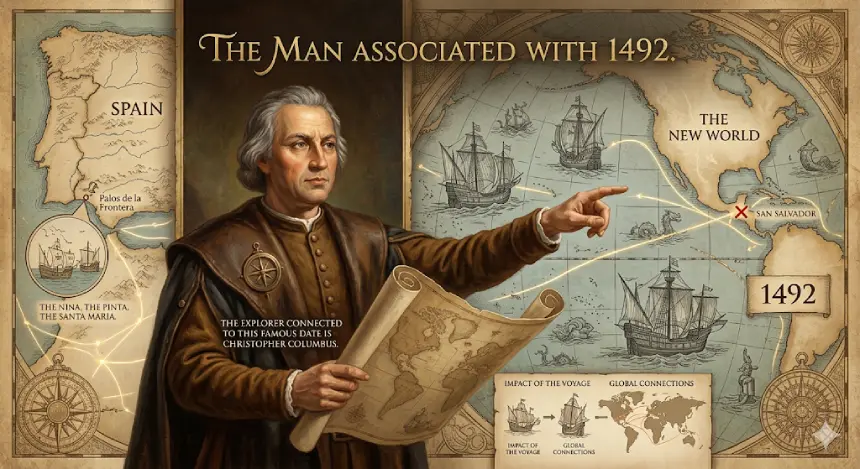

You’ve probably heard this since childhood: “In 1492, Columbus sailed the ocean blue…” But here’s the thing — the full story behind who discovered America in 1492 is a lot more layered than that simple rhyme.
Let’s slow it down for a second. What does “discovered” even mean here? And discovered… for whom?
A Familiar Name, But Let’s Double-Check
Before jumping to the answer, take a guess:
Who is most commonly linked to the discovery of America in 1492?
- Leif Erikson
- Christopher Columbus
- Ferdinand Magellan
You already feel the answer coming, don’t you?
The Man Associated With 1492
The explorer connected to this famous date is Christopher Columbus.
In 1492, Columbus sailed under the Spanish flag and reached parts of the Caribbean, including islands like the Bahamas. This voyage opened the door for European exploration of the Americas.
But Did Columbus Actually “Discover” America?
Now here’s where things get real — and a bit more honest.
If you’re searching “did Christopher Columbus really discover America”, the answer depends on perspective.
- Indigenous peoples had already lived in the Americas for thousands of years
- Norse explorer Leif Erikson likely reached North America around the year 1000
- Columbus never actually set foot on mainland North America
So while Columbus is credited in traditional history, he didn’t “discover” a new land — he connected two worlds that didn’t know each other existed.
What Happened in 1492 Exactly?
Let’s zoom into the actual journey.
- Columbus set sail with three ships: the Niña, the Pinta, and the Santa Maria
- His goal was to find a westward route to Asia
- Instead, he landed in the Caribbean, thinking he had reached the Indies
- This is why Indigenous people were mistakenly called “Indians”
So the event wasn’t just a discovery — it was a massive geographical misunderstanding that changed world history.
Quick Knowledge Check
Let’s lock it in:
Who is traditionally said to have discovered America in 1492?
A) Leif Erikson
B) Christopher Columbus
C) James Cook
Correct answer: B
But now you know the deeper story behind that answer.
Interesting, Surprising, and Slightly Awkward Facts
History isn’t always clean and simple — and this topic proves it.
- Columbus made four voyages, not just one
- He believed until his death that he had reached Asia, not a new continent
- The term “America” actually comes from Amerigo Vespucci, not Columbus
- Viking settlements in Newfoundland prove pre-Columbus exploration
- The encounter between Europeans and Indigenous peoples led to huge cultural and historical consequences
Here’s a strange twist: one of the most famous “discoveries” in history is technically based on a misunderstanding.
Let Me Ask You Something
If a place is already inhabited, can it really be “discovered”?
It’s one of those questions that makes you rethink how history is taught.
Why This Question Still Matters
Even in 2026, people search “who discovered America in 1492” because it’s simple on the surface — but complex underneath.
- It opens discussions about history vs perspective
- It highlights the importance of Indigenous history
- It shows how narratives can change over time
So yes, Columbus is the textbook answer.
But the real story? That’s much bigger — and far more interesting.