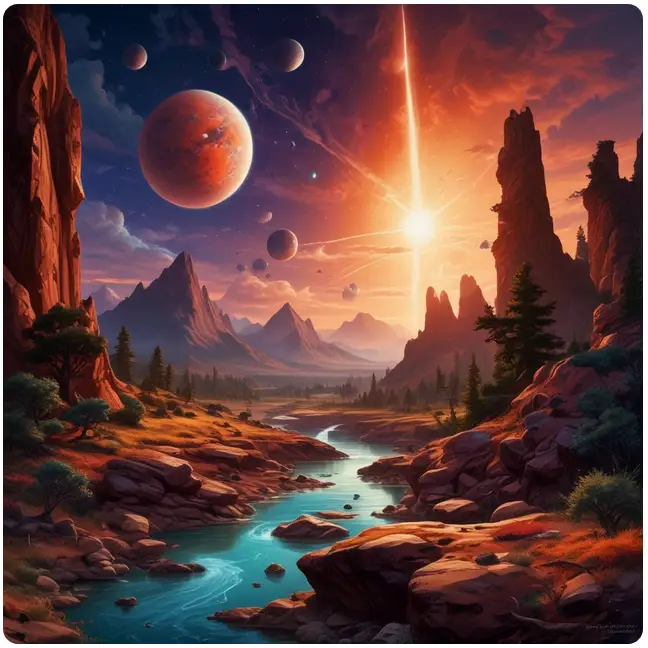

Far beyond what textbooks ever covered, the universe hides details so strange and fascinating that they feel almost unreal (That Will Change How You See the Universe). Space isn’t just stars and planets—it’s a place where reality bends, time stretches, and the impossible somehow becomes normal.
You probably learned the basics in school, but some of these facts will blow your mind in completely unexpected ways. There are discoveries scientists have confirmed over the years—and even refined in recent studies—that most people never hear about, and I promise, a few of these will stick with you long after you finish reading.
The Space Truths School Never Told You
Instead of the usual facts, let’s explore the hidden, weird, and truly incredible side of space science. These aren’t the things you memorized for exams—these are the kinds of discoveries that make you stop and rethink everything you thought you knew.
1. Space Is Completely Silent
Sound needs a medium like air to travel, and in the vacuum of space, there’s nothing to carry those vibrations. That means explosions, collisions, and cosmic events happen in total silence.
2. A Spoonful of a Neutron Star Weighs Billions of Tons
Neutron stars pack immense mass into a tiny space. Just a small amount of their material would weigh more than a mountain on Earth.
3. There Are More Stars Than Grains of Sand on Earth
Estimates suggest there are more stars in the observable universe than grains of sand on all Earth’s beaches combined. It’s a scale that’s almost impossible to imagine.
4. You Could Fit All Planets Between Earth and the Moon
The distance between Earth and the Moon is so vast that all other planets could fit in between—with room to spare.
5. Space Isn’t Completely Empty
Even the vacuum contains particles, radiation, and quantum fluctuations, making “empty space” more active than it sounds.
6. Some Planets Float
Gas giants like Saturn are less dense than water, meaning theoretically, they could float if there were an ocean big enough.
7. A Day on Mercury Lasts Longer Than Its Year
Mercury rotates slowly, so one full day-night cycle is longer than the time it takes to orbit the Sun.
8. There Are Planets That Rain Glass
On certain exoplanets, strong winds and extreme heat create sideways rain made of glass particles—one of the most extreme weather systems known.
9. Black Holes Can Stretch Time
Near a black hole, time slows dramatically compared to distant observers, making it one of the strangest effects in physics.
10. The International Space Station Is Visible From Earth
You can actually see the ISS with the naked eye as it passes overhead, appearing like a fast-moving bright star.
11. The Sun Makes Up 99.8% of Our Solar System’s Mass
Almost all the mass in our solar system belongs to the Sun, showing just how dominant it is gravitationally.
12. Some Moons Have Oceans Beneath Ice
Moons like Europa are believed to hide vast oceans under thick icy surfaces, raising the possibility of extraterrestrial life.
13. Space Travel Affects the Human Body
Astronauts experience muscle loss, bone density changes, and even vision shifts during long missions in microgravity.
14. There Are Rogue Planets With No Star
Some planets drift freely through space without orbiting any star, wandering the galaxy in complete darkness.
15. The Universe Is Expanding Faster Than Expected
Dark energy is causing the expansion of the universe to accelerate, a discovery that changed modern cosmology.
16. Light Takes Time to Travel
When you look at stars, you’re seeing them as they were in the past—sometimes millions or billions of years ago.
17. Some Galaxies Are Colliding Right Now
Galactic collisions are common in the universe, slowly reshaping structures over millions of years.
18. You Are Made of Star Material
Elements in your body were formed in stars that exploded long before Earth existed, connecting us directly to the cosmos.
19. There Are More Galaxies Than We Thought
Recent observations suggest there could be trillions of galaxies in the observable universe—far more than earlier estimates.
20. Space Still Holds Endless Mysteries
Even with modern telescopes and 2026-level technology, we’ve explored only a tiny fraction of the universe.
The more we learn about space, the more it challenges what we think is possible. So here’s something to think about: which of these incredible space facts surprised you the most? Share it and see if others are just as amazed by the universe as you are.
FAQ
Q1: Are these space facts scientifically accurate?
A1: Yes, all facts are based on astronomy research, observations, and updated scientific understanding.
Q2: Why aren’t these facts taught in school?
A2: Many are advanced or recently discovered concepts that go beyond basic education curricula.
Q3: Can we observe any of these phenomena from Earth?
A3: Yes, events like the ISS passing or certain stars and planets can be seen with the naked eye or telescopes.
Q4: How do scientists learn about distant space?
A4: They use telescopes, satellites, spectroscopy, and mathematical models to study light and cosmic behavior.
Q5: Is space exploration still active today?
A5: Absolutely. New missions and discoveries continue to expand our understanding of the universe.
Q6: Could humans travel to other planets soon?
A6: Research is ongoing, but long-distance human space travel still faces major technological challenges.