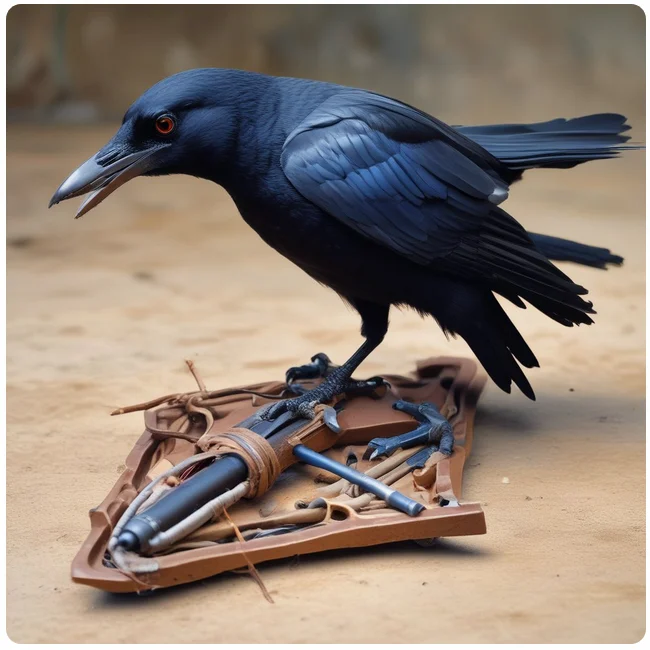

When Beaks Outperform Your Toolbox
Some birds treat sticks like magic wands, turning ordinary twigs into precision tools while humans fumble with screwdrivers. The New Caledonian crow, for example, makes your weekend DIY project look like child’s play—tiny feathered engineers crafting solutions that would leave most humans scratching their heads.
Brains Bigger Than Your Smartphone
Despite their small size, these crows can:
- Shape twigs into hooks
- Bend leaves to extract hidden insects
- Store step-by-step problem-solving techniques
- Understand sequences of actions for complex tasks
Crows take experimentation seriously. They don’t just peck—they innovate.
Feathered Experimenters
Instruction manuals? Never heard of them. Every tool is crafted through trial, error, and occasional comic misfire. They test sticks, twigs, and leaves. They select, modify, and execute with surprising precision, without getting distracted by shiny objects or idle chatter.
Comparing Skills: Crow vs. Toddler
Toddlers try to stack blocks and usually fail hilariously. Crows tackle the same challenge flawlessly.
- Toddler drops a block → crow adjusts a twig to hook a snack
- Toddler cries → crow calmly continues
- Toddler celebrates → crow casually enjoys the reward
Evolution clearly handed out tiny hard hats.
2026 Insights: Innovation on the Wing
Studies in 2026 reveal that these crows can:
- Use multiple tools in sequence
- Solve puzzles once designed for primates
- Remember solutions months later
- Teach younger birds by example
Aerial apprenticeships, in other words.
Feathered Facts That Will Shock You
- Wire-bending to retrieve treats is observed
- Nuts are dropped onto roads to be cracked by cars
- Tool-making is culturally transmitted
- Multi-step problem-solving occurs naturally
- Eyes judge distance with millimeter precision
- Social hierarchy influences tool strategy
- Problem-solving skills rival some mammals
- Objects can be modified mid-task if first attempt fails
- Individual humans are recognized
- Danger prompts strategic adaptation
- Experimentation is constant
- Tools can be combined for complex tasks
- Curiosity drives innovation
- Nesting sometimes involves structural engineering
- Playfulness coexists with technical genius
Humor Break: Birds With Blueprints
Picture a crow wearing a tiny hard hat, wielding a stick like a crowbar while humans fumble with peanut butter jars. Nature clearly knows how to mix genius with comedy.
FAQs About Feathered Engineers
Can crows make tools from scratch?
Yes, sticks, leaves, and even wires are shaped for specific tasks.
Is this learned or instinctual?
Primarily learned; young birds observe adults.
How complex is their tool use?
They can perform multi-step sequences rivaling primate experiments.
Do all crows exhibit this behavior?
Mostly New Caledonian crows, though other corvids show simpler forms.
Can they plan ahead?
Yes, they anticipate needs and prepare tools in advance.
Are tools ever used socially?
Sometimes, especially for teaching or influencing peers.
Do they improve with practice?
Absolutely; efficiency increases with repetition.
Can they select different tools for different tasks?
Yes, depending on shape, material, and difficulty.
What’s the most surprising tool use?
Using a leaf as a hook to retrieve prey buried under sand.
Rapid-Fire Engineering Facts
- Wingspan does not limit dexterity
- Eye-beak coordination rivals mammals
- Social learning develops skills
- Problem-solving involves trial, error, and redesign
- Water displacement used for floating food
- Both beak and claws manipulate objects
- Cultural knowledge transfer documented
- Objects differentiated based on function
- Individual personalities affect innovation
- Foraging varies with environment
- Curiosity leads to exploration
- Tools sometimes hidden for later
- Success improves with repetition
- Play overlaps with problem solving
- Cognitive flexibility allows improvisation
- Observation informs strategy
- Temporary structures aid access
- Memory retention affects efficiency
- Adaptations occur in new challenges
- Feathers occasionally interfere with tool use
Share for thanks 🙂