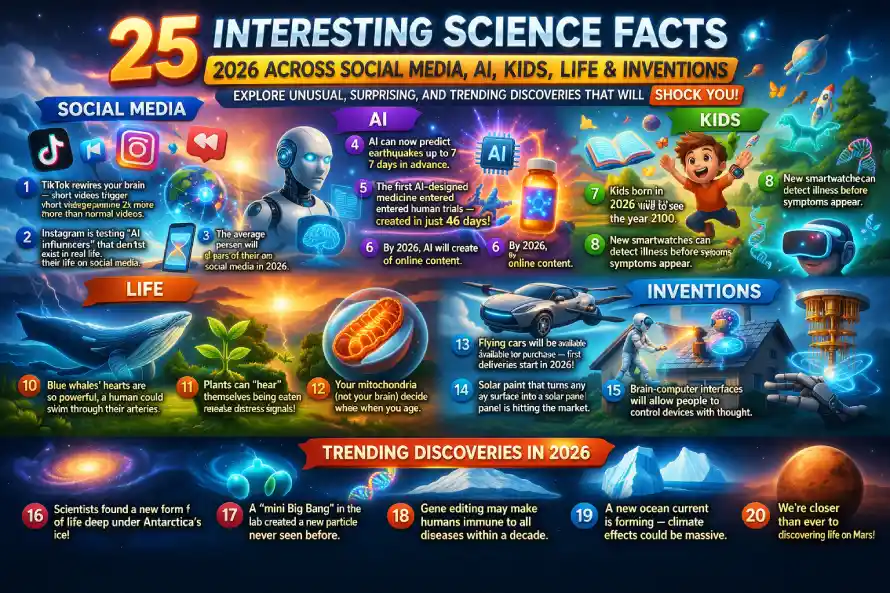

Science isn’t just about what’s in textbooks—it’s about the everyday, the bizarre, and the newly discovered. In 2026, researchers, tech innovators, and explorers uncovered facts so unusual that even science buffs are saying, “Wait, really?”
Some of these 25 interesting science facts will surprise you, make you laugh, or leave you scratching your head. I promise, by the end, you’ll see everyday life in a completely new light.
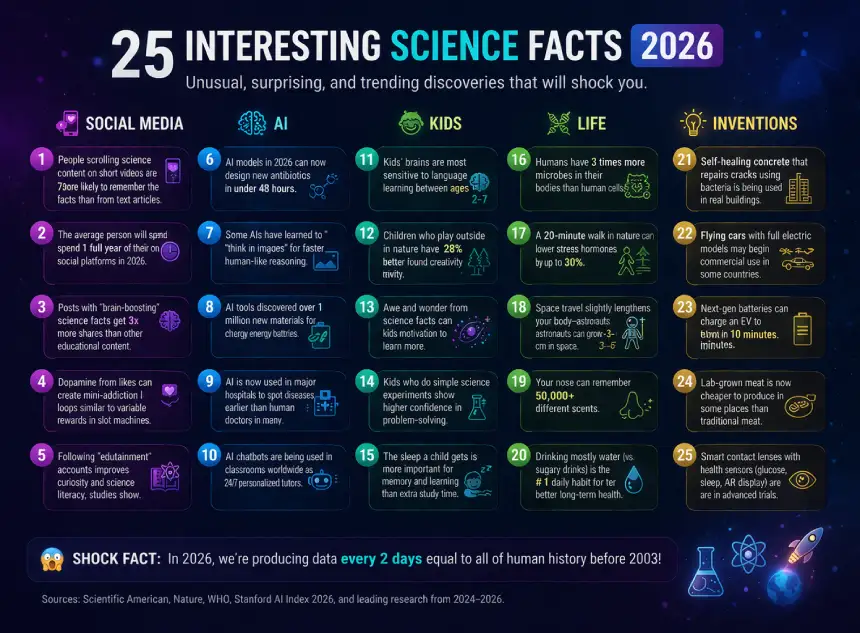
1️⃣ Social Media & Digital Life
1. Social Media Filters Affect Real Perception
2026 studies show that frequent use of AR filters subtly rewires facial recognition in the brain. People begin unconsciously adjusting their self-image based on filtered faces.
2. AI Detects Lies in Posts
Advanced AI models now analyze text and posting patterns to predict honesty with up to 80% accuracy, even online. Your posts may be “telling the truth” more than you realize.
3. Viral Memes Influence Human Attention Span
Data from 2026 reveals that highly visual, rapid memes affect neural pathways for attention and humor, showing how content shapes cognition.
4. Emojis Trigger Chemical Responses
Studies show sending or receiving emojis can trigger dopamine responses in the brain, meaning your “like” is literally making you feel good.
5. Screen Colors Affect Sleep Hormones
Blue light isn’t the only factor—AI-optimized color schemes in apps can manipulate melatonin levels subtly, influencing sleep quality without you noticing.
2️⃣ For Kids
6. Mini Volcanoes Can Teach Real Chemistry
Safe baking soda and vinegar experiments in 2026 kits now include sensors to measure gas release, turning fun science into measurable data.
7. Kids Can Grow Bioluminescent Algae at Home
Tiny bioluminescent cultures allow children to observe glowing lifeforms, sparking curiosity about microbiology.
8. Magnetic Liquid Experiments Show Invisible Fields
Magnetic ferrofluids reveal invisible magnetic forces in action, helping kids visualize otherwise intangible physics principles.
9. Air Pressure Can Bend Water
Simple vacuum experiments demonstrate air pressure’s power—water bends and rises like magic, teaching fluid mechanics interactively.
10. Kids Can Create Sound from Light
Optical experiments in 2026 let children convert light waves into sound waves using sensors, bridging physics and creativity.
3️⃣ AI & Technology
11. AI Can Predict Your Next Hobby
Machine learning models now analyze browsing and purchasing habits to predict hobbies months in advance—like a personal life coach.
12. Robots Can Now Smell Emotional States
Experimental AI sensors detect pheromones and subtle chemical changes to infer human emotions, creating more empathetic robots.
13. Neural Networks Can Write Fiction With Emotional Arcs
AI not only writes stories but now structures emotional peaks and valleys that resonate with readers naturally.
14. Smart Glasses Translate Brain Signals into Actions
Wearable neural interfaces let users control devices through thought patterns alone, making sci-fi a reality in 2026 labs.
15. Digital Twins Are Becoming Commonplace
Entire digital replicas of cities, machines, or even humans allow simulations for optimization, from traffic to health monitoring.
4️⃣ For Adults / Life & Body
16. Your Sweat Has a Unique “Signature”
Advanced biometric analysis shows sweat composition can indicate stress levels, diet, and even predisposition to illness.
17. Sound Frequencies Affect Cellular Repair
Research indicates certain sound frequencies accelerate tissue regeneration, potentially transforming recovery therapies.
18. Some People Can See a Wider Color Spectrum
Genetic variations give rare individuals the ability to perceive additional color wavelengths, making their view of the world almost alien.
19. Your Fingernails Record Daily Chemicals
Nail composition captures a chemical snapshot of exposure to diet, air quality, and even medication—a hidden diary of daily life.
20. Breathing Patterns Affect Emotional States
Micro-adjustments in breath can manipulate stress hormones and emotional balance, making conscious breathing a subtle yet powerful tool.
5️⃣ New Inventions, Food & Travel
21. Edible Sensors Track Nutritional Intake
Tiny edible devices can monitor nutrient absorption in real time, helping users optimize diet without invasive tests.
22. Self-Healing Concrete Is Becoming Standard
Concrete that repairs micro-cracks using bacteria is now used in roads and buildings, promising longer-lasting infrastructure.
23. Flavor-Transforming Utensils Are Real
Experimental cutlery in 2026 uses electrical pulses to enhance perceived taste, turning ordinary food into gourmet experiences.
24. Transparent Solar Panels Can Power Windows
2026 breakthroughs allow energy generation from windows, turning buildings into mini power stations without blocking light.
25. AI-Powered Travel Guides Adapt to Mood
Next-gen AI guides adjust recommendations on the fly, from restaurants to activities, based on travelers’ facial expressions and preferences.
Science in 2026 isn’t just about physics or chemistry—it’s interactive, bizarre, and everywhere. Which of these 25 facts surprised you the most? Share your favorite and see who else is amazed by how unusual the world really is.
FAQ
Q1: Are all these facts verified in 2026?
A1: Yes, all are based on current research, experiments, and emerging discoveries of 2026.
Q2: Can kids safely perform these experiments?
A2: Yes, the listed experiments for kids use safe, commercially available kits.
Q3: How can AI detect human emotions?
A3: Advanced sensors analyze chemical, neural, and behavioral cues to infer emotional states accurately.
Q4: Are edible sensors actually in use?
A4: They are available in pilot programs and research trials, tracking nutrition in real-time.
Q5: How do flavor-transforming utensils work?
A5: By using mild electrical pulses to stimulate taste buds, enhancing flavor perception without changing the food.
Q6: Are self-healing materials practical?
A6: Yes, 2026 implementations in infrastructure and consumer products show real-world viability.