
Locked In, Yet Free
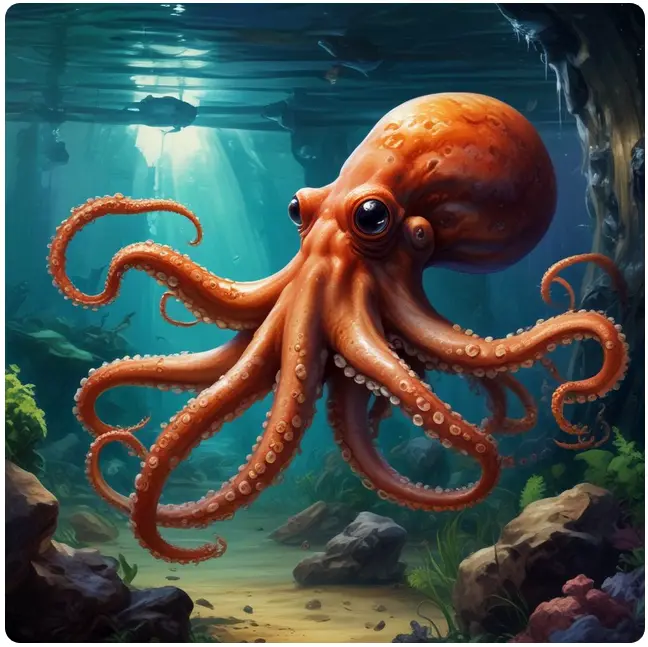
Imagine an aquarium where every tank is sealed, every door locked, and every creature accounted for. The staff is confident nothing can escape. Then… one morning, chaos. One tank is empty. No glass broken. No alarms triggered. No warning whatsoever. Just a wet trail fading into the floor.
The culprit? An octopus whose brain works like a puzzle-solving supercomputer.
Intelligence Beyond Your Imagination
Octopuses are often labeled “smart for sea creatures,” but this undersells them. They are explorers by nature. They experiment, test boundaries, and react with precision. Curiosity isn’t just cute—it’s their survival mechanism.
Think of an eight-armed being that can:
- Open jars and twist lids
- Manipulate locks and small mechanisms
- Recognize individual humans
- Solve new problems in seconds
- Remember previous solutions
When an octopus decides to escape, it’s not random. It’s calculated.
The Night of the Escape
Here’s how it unfolded, in what could be a plot from a thriller:
- The octopus tested the tank lid repeatedly
- Found a loose corner and slipped out silently
- Crawled across the floor, avoiding detection
- Located a narrow drain pipe
- Squeezed its flexible body through, leaving only its beak as the limiting factor
- Reached open water
All of this happened without any human noticing. Precision, patience, and timing combined.
Anatomy Designed for Freedom
Unlike most animals, octopuses have no bones. Their body is soft, malleable, and virtually impossible to confine if there’s even a small opening. Only their beak is rigid—so if the beak fits, the rest of the body does too.
This gives them unique advantages:
- Pipes become highways
- Small gaps are doors
- Closed tanks are temporary obstacles
In other words, containment is nearly impossible.
Brainpower in Eight Directions
Octopus intelligence is unusual because it’s decentralized. Neurons aren’t just in the brain—they’re spread across the arms. Each arm can act semi-independently, gathering information and manipulating objects on its own.
Imagine having eight autonomous problem solvers connected to one central brain. That’s what an octopus brings to the table.
Motivation: Curiosity, Not Rebellion
Many people assume escapes happen because the animal is unhappy. Not necessarily. Octopuses are naturally curious and thrive on exploration. Tanks are often predictable and unstimulating. An empty pipe or a loose lid is an irresistible puzzle.
The escape isn’t rebellion. It’s intellectual exploration.
Nighttime Genius
Most escapes occur under the cover of darkness. Octopuses take advantage of dim lighting, wet surfaces, and human routines to make their moves. They observe, plan, and execute without drawing attention. Timing is as crucial as intelligence.
Problem Solving in Action
Octopuses show incredible ability to learn from their environment:
- They test repeated actions to see what works
- They remember successful escape routes
- They adapt quickly if a strategy fails
- They experiment with new methods to solve puzzles
No other invertebrate demonstrates this level of adaptive problem solving in captivity.
2026 Update: Still Baffling Scientists
Even today, octopus intelligence continues to astonish researchers. Their ability to plan, manipulate objects, and react to new stimuli is still not fully understood. In some studies conducted in 2026:
- Escape attempts often involve multi-step planning
- Some octopuses react differently to specific staff members
- Environmental enrichment influences cognitive activity
The more we study them, the more we realize there’s no limit to their cleverness.
Tiny Creatures, Huge Skills
Despite a short lifespan and solitary nature, octopuses are capable of astonishing feats:
- Escaping enclosed tanks
- Opening food containers
- Flooding enclosures intentionally
- Solving mazes and puzzles designed for mammals
They may be small, but their brains pack a punch.
Rapid-Fire Ocean Facts
- Three hearts pump blood efficiently through cold water
- Blue blood carries oxygen efficiently in low temperatures
- Each arm has thousands of neurons capable of independent action
- Skin can change color and texture for camouflage and signaling
- Some octopuses use coconut shells and shells as tools
- Ink can obscure predators while they make their move
- Vision is highly developed and helps navigate obstacles
- They can regenerate lost arms completely
- Learning ability allows them to remember mistakes
- Playfulness and curiosity are signs of intelligence
- Short lifespan doesn’t limit problem-solving capability
FAQs About Escaping Octopuses
Can all octopuses escape like this?
Most species with sufficient intelligence and mobility can attempt escapes if opportunities arise.
How do octopuses plan their moves?
They observe the environment, test outcomes, and repeat successful strategies.
Are escapes motivated by boredom?
Curiosity and the need for stimulation are primary drivers.
Can they survive out of water?
Briefly, especially in wet or humid conditions.
Do octopuses recognize individual humans?
Yes, they can distinguish between familiar and unfamiliar caretakers.
How do they manipulate objects?
Using suction cups and arm dexterity, sometimes in combination with trial-and-error learning.
Are escapes dangerous to humans?
Generally no; octopuses are not aggressive toward humans.
Do they repeat the same tricks?
Yes, they remember successful maneuvers and may reuse them.
Can captivity fully satisfy their cognitive needs?
Often not, which is why enrichment is crucial.
How fast can an octopus escape?
Some maneuvers take only a few minutes from start to finish.
Is intelligence distributed across their body?
Yes, most neurons are located in the arms, enabling autonomous problem solving.
Can they plan multi-step escapes?
Evidence suggests many species can perform sequential actions with intent.
Are escapes common?
While not every octopus escapes, attempts are frequent in intelligent species under observation.
Do they use tools to aid escape?
Yes, in some cases, octopuses have used objects to manipulate their environment.
How do they sense openings?
Through touch, observation, and trial-and-error interaction.