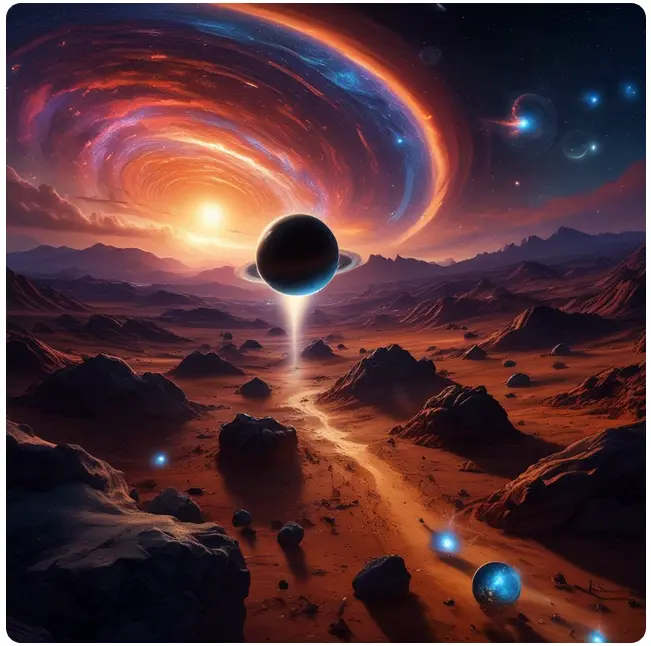

The universe is full of surprises, and sometimes the latest research uncovers phenomena so incredible you might have to read twice to believe them. From distant galaxies to the tiniest cosmic particles, space constantly challenges our imagination.
Even scientists are amazed by these recent discoveries. You won’t believe some of the facts confirmed in 2026 and the years leading up to it—they reveal a cosmos far stranger and more spectacular than we ever imagined.
Prepare to Be Shocked by Space Science
Let’s explore astonishing, little-known, and sometimes mind-boggling space facts. From black holes to rogue planets, these revelations show the universe’s extraordinary power and mysteries.
1. A Planet Made Entirely of Diamonds Exists
55 Cancri e, a planet twice the size of Earth, has a carbon-rich interior where high pressure turns carbon into diamond—literally a sparkling world confirmed by recent observations.
2. Black Holes Can “Sing”
Gravitational waves from merging black holes produce vibrations detectable by instruments, creating a cosmic symphony unlike anything on Earth.
3. Some Stars Move Faster Than 1,000 km/s
Hypervelocity stars escape galaxies entirely, a discovery confirmed by astronomers in 2026. Their speed defies everyday intuition.
4. Rogue Planets Drift Alone
Some planets wander through space without orbiting any star, silently floating through the galaxy and defying expectations of planetary systems.
5. Galaxies Can Collide Without Destroying Stars
Despite massive interactions, individual stars rarely collide because of the enormous distances separating them, confirmed by detailed astronomical imaging.
6. Some Exoplanets Rain Glass Sideways
Extreme winds on HD 189733b create molten glass rain, an incredible and harsh environment revealed through spectroscopy.
7. The Universe Is Expanding Faster Than Expected
Recent observations confirm that cosmic expansion accelerates due to dark energy, changing our understanding of the universe’s fate.
8. Neutron Stars Can Spin 700 Times per Second
These stellar remnants rotate at mind-blowing speeds, packing more mass than our Sun into a tiny sphere.
9. A Day on Venus Is Longer Than Its Year
Venus rotates so slowly that one full rotation takes longer than it takes to orbit the Sun—a discovery that reshapes our planetary knowledge.
10. Black Holes Slowly Evaporate
Hawking radiation predicts black holes lose mass over time, a phenomenon confirmed through simulations and indirect observations.
11. Water Exists on Distant Moons
Scientists confirmed water ice on moons like Europa and Enceladus, hinting at the potential for life in unexpected places.
12. Some Stars Explode as Superluminous Supernovae
These explosions can outshine entire galaxies, showing the extremes of stellar physics.
13. Cosmic Microwave Background Shows Anomalies
Patterns in the CMB suggest subtle irregularities in the early universe, offering clues about cosmic inflation.
14. Gravitational Lensing Lets Us See Distant Galaxies
Massive objects warp spacetime, bending light and allowing astronomers to study galaxies billions of light-years away.
15. The Largest Known Structure Spans 10 Billion Light-Years
The Hercules–Corona Borealis Great Wall challenges our understanding of cosmic scale and structure formation.
16. Pulsars Emit Precise Pulses of Light
These neutron stars act like cosmic lighthouses, helping scientists measure cosmic distances and test physics.
17. Some Galaxies Rotate Differently Than Expected
Observations reveal unusual galactic rotation curves, confirming the presence of dark matter.
18. Space Is Not Empty
Even the vacuum contains particles, radiation, and magnetic fields, shaping phenomena like cosmic rays.
19. Planets Orbiting Two Stars Exist
Circumbinary planets demonstrate that solar systems can be far stranger than our own.
20. Light Can Be Bent by Gravity
Einstein’s relativity predicts and confirms gravitational lensing, proving massive objects warp spacetime.
21. Rogue Black Holes Wander the Galaxy
Some black holes are untethered and move through space silently, detectable only through their gravitational effects.
22. Some Stars Are Older Than Earth
Certain stars formed over 13 billion years ago, predating our solar system entirely.
23. Galaxies Can Merge to Form New Ones
Galactic collisions create new star clusters and structures, showing cosmic evolution in action.
24. Dark Matter Makes Up Most of the Universe
Over 80% of matter is invisible, confirmed through gravitational effects on galaxies and clusters.
25. Space Still Holds Infinite Mysteries
Every new telescope, satellite, and study in 2026 continues to reveal phenomena that challenge our imagination and scientific understanding.
Even the most distant corners of the cosmos hide unbelievable facts. Which one of these confirmed space discoveries surprised you the most? Share it and spark curiosity about the universe’s infinite wonders.
FAQ
Q1: Are these space facts scientifically confirmed?
A1: Yes, all listed facts are verified by recent astronomical observations, research, and 2026 findings.
Q2: Can we observe these phenomena from Earth?
A2: Some, like supernovae, eclipses, and pulsars, can be seen with telescopes or special equipment.
Q3: Do these discoveries have practical applications?
A3: Certain phenomena inform satellite navigation, astrophysics research, and our understanding of physics and chemistry.
Q4: Where can I learn more about these space facts?
A4: NASA updates, scientific journals, and 2026 space research publications provide detailed explanations.
Q5: Are these facts suitable for students and educators?
A5: Absolutely—they inspire curiosity, critical thinking, and educational exploration.
Q6: How often do scientists confirm new space facts?
A6: Continuously. With advancing telescopes, satellites, and simulations in 2026, discoveries happen almost yearly.