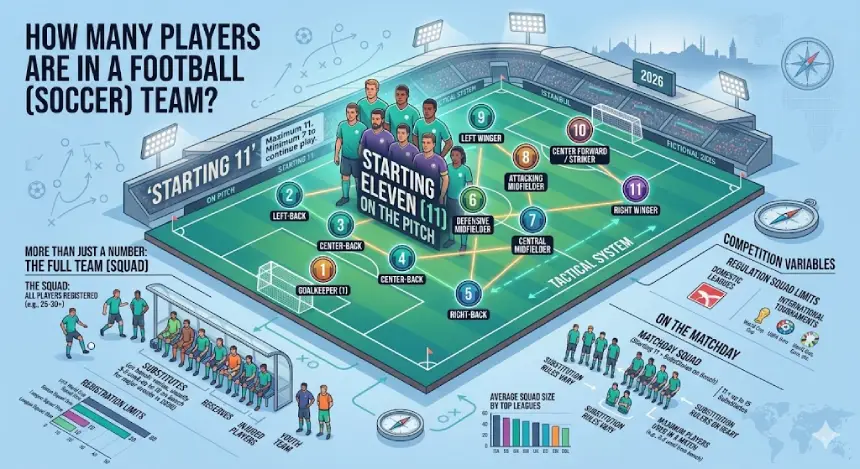

Let’s picture this for a second. A stadium is full, the whistle blows, and 22 players are on the pitch. But wait… how many players are actually on one football (soccer) team during a match?. It sounds like a simple question — but like most things in football, there’s a bit more going on beneath the surface.
The Straight Answer (But Stay With Me)
A standard football (soccer) team has 11 players on the field at one time.
That includes:
- 10 outfield players
- 1 goalkeeper
So if you’re searching “how many players are on a soccer team on the field”, the answer is clearly 11.
But don’t scroll away yet — this gets more interesting.
So Why 11 Players?
You might be wondering “why does a soccer team have 11 players”. It’s not random.
The number comes from the early days of organized football in England. Schools and clubs standardized the game in the 19th century, and 11 players became the balance between:
- Space on the field
- Strategy and positioning
- Physical endurance
Too many players? Chaos.
Too few? The game loses structure.
Eleven turned out to be the sweet spot.
What About the Full Squad?
Here’s where people often get confused.
While only 11 players are on the pitch, a full team includes substitutes and reserves.
In modern competitions:
- Matchday squads usually have 15–23 players
- Teams can make 5 substitutions (in most competitions today)
So if you’re asking “how many players are in a soccer team including substitutes”, the answer is:
More than 11 — usually up to 23 in total.
Positions: Not Just Running Around
Each of the 11 players has a role.
- Goalkeeper
- Defenders
- Midfielders
- Forwards
And no, not everyone just chases the ball (even if it sometimes looks like it in amateur games).
Fun, Weird, and Surprisingly Cool Football Facts
Let’s make this a bit more fun — because football always has stories behind the numbers.
- A football match starts with 22 players total (11 per team)
- If a team drops below 7 players, the match can’t continue
- Goalkeepers are the only players allowed to use hands — but only inside the penalty area
- Early versions of football didn’t always have fixed player numbers
- Some youth games use smaller teams (like 5-a-side or 7-a-side)
Here’s a weird one: in some chaotic matches, teams have finished with 8 or 9 players due to red cards — and still managed to win.
Let Me Ask You This
If you could redesign football today, would you keep 11 players?
Or try something different — like faster 7-player matches or larger 15-player teams?
It’s funny how a number decided over a century ago still defines the world’s most popular sport.
Why This Question Still Gets Searched
Even in 2026, people look up “how many players are in a football team” because:
- New fans are discovering the sport
- Different formats (like futsal) create confusion
- Rules evolve (like substitutions), but the core stays the same
And that core is simple: 11 players, one ball, endless possibilities.
Football isn’t just about numbers — but sometimes, one number explains everything.
Eleven players.
One team.
And a game that somehow connects the entire world.