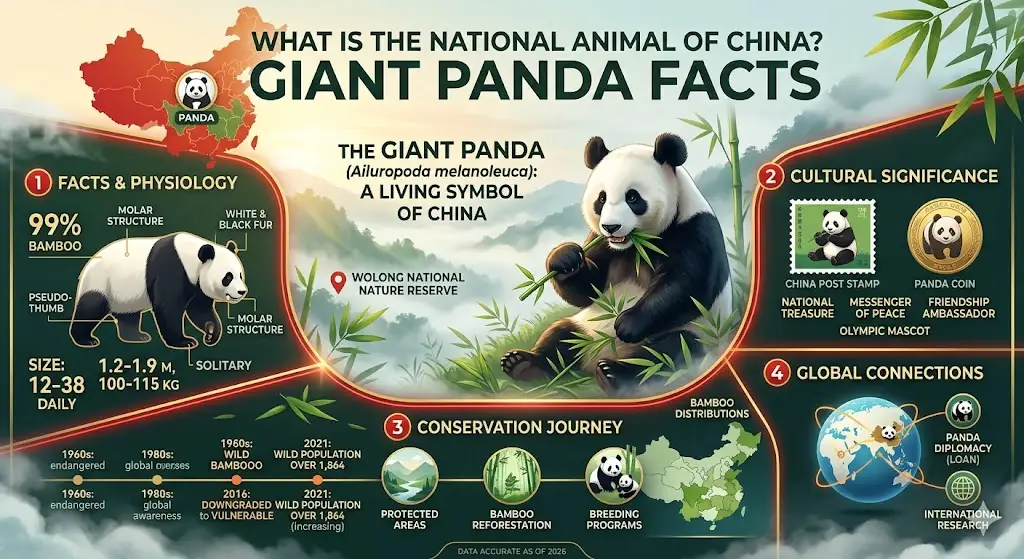

Let’s try something different. Imagine you’re scrolling and suddenly see a black-and-white animal lazily chewing bamboo. Be honest… you already know what it is, right?
Now here’s the real question: what is the national animal of China and why was this particular creature chosen? There’s a story behind it, and it’s not just about being cute.
Quick Guess Game
No overthinking — just go with your instinct:
Which animal represents China?
- Tiger
- Panda
- Dragon
If your brain immediately said “panda,” you’re on the right track. But let’s not rush.
The Official Answer
China’s national animal is the Giant Panda.
Yes, that fluffy, slow-moving, bamboo-loving animal is more than just adorable — it’s a powerful national symbol.
Why the Panda? (There’s More Than Cuteness Here)
At first glance, choosing a panda might feel like picking the softest option in the animal kingdom. But there’s meaning behind it.
If you’re wondering “why is the giant panda the national animal of China”, here’s what stands out:
- Pandas are native only to China, making them unique
- They represent peace and harmony due to their calm nature
- Their black-and-white colors are often seen as a symbol of balance (yin and yang)
- China has used pandas in diplomacy, gifting them to other countries
So yeah, it’s not just about being cute — it’s about identity and symbolism.
Let’s Talk Reality for a Second
Interestingly, pandas weren’t always just symbols. For a long time, they were endangered.
China made serious conservation efforts, and today:
- Panda populations are slowly recovering
- Protected reserves have expanded
- The species is now considered vulnerable instead of endangered
That makes the panda not just a symbol of China, but also a symbol of successful wildlife protection.
Mini Quiz (Don’t Skip This One)
Let’s make sure it sticks:
What is the national animal of China?
A) Red Panda
B) Giant Panda
C) Snow Leopard
Correct answer: B
If you got it right in one second, that’s instinct + knowledge working together.
Interesting, Weird, and Surprisingly Fun Panda Facts
This is where things get even better. Pandas are full of contradictions.
- They belong to the bear family, but eat mostly bamboo (about 99% of their diet)
- A panda can spend up to 14 hours a day eating
- Baby pandas are born tiny — about the size of a stick of butter
- Despite their calm look, they have strong jaws and powerful bites
- Each panda has a unique pattern of black patches, like a fingerprint
Here’s a weird one: pandas have a special “thumb” (actually a modified wrist bone) just to hold bamboo. Evolution really said, “Let’s make this work.”
Let Me Ask You Something
If you had to choose a national animal for a country, would you go for:
- Strength (like a lion or eagle)?
- Speed (like a cheetah)?
- Or something peaceful and unique like a panda?
China clearly chose symbolism over aggression — and that says a lot.
Why the Panda Still Matters
Even today, the giant panda is more than just a mascot.
- It represents China’s cultural identity
- Plays a role in international diplomacy (panda diplomacy)
- Attracts millions of visitors to conservation centers
- Raises awareness about wildlife protection worldwide
And honestly? It’s one of the few national symbols that can make people smile instantly.
That’s a rare kind of power.
One Last Thought
Next time you see a panda, don’t just think “cute animal.”
Think: history, diplomacy, conservation… and a country that chose softness as a symbol of strength.