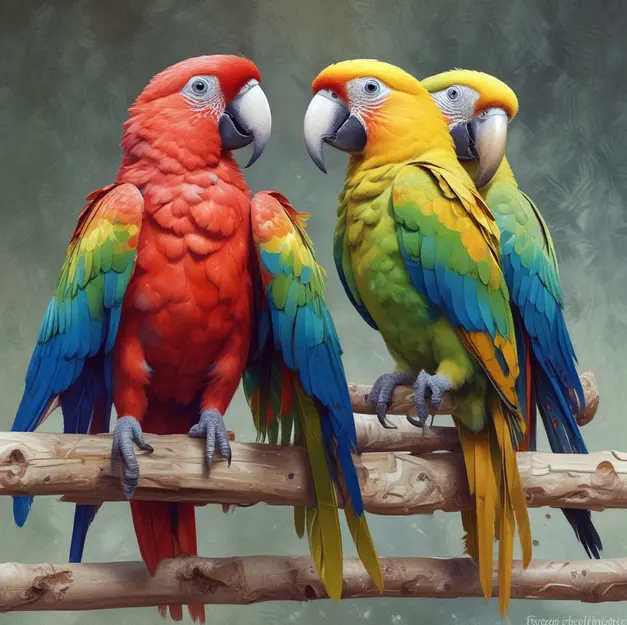

Reasoning Skills Hidden Behind Colorful Feathers
Bright feathers, playful movements, and a voice that can mimic humans—yet parrot logical thinking facts reveal something far more impressive than simple imitation. These birds don’t just repeat sounds; they analyze situations, test options, and reach solutions using reasoning that feels almost calculated.
Place a parrot in front of a locked mechanism, a sequence-based puzzle, or a multi-step food challenge… and something unexpected happens.
No panic.
No random pecking.
A pause.
A look.
Then action.
So here’s the real question:
Is that instinct… or actual logic at work?
Not Mimicry—Decision-Making
Talking ability often steals the spotlight, but problem-solving tells the real story.
- Selecting correct objects from multiple choices
- Ignoring distractions to focus on goal
- Completing tasks in proper order
- Adjusting behavior after failed attempts
That’s not copying.
That’s filtering information and making decisions.
Step-by-Step Thinking in Action
One experiment placed food behind a mechanism requiring multiple actions:
- Pull a string
- Drop a latch
- Rotate a piece
- Access reward
No training sequence. No hints.
The parrot didn’t rush.
It worked through each step logically, sometimes pausing between actions as if evaluating what just happened.
Now pause yourself.
How many times have humans rushed a problem… and made it worse?
2026 Logic Beyond Expectation
Recent cognitive studies brought surprising insights:
- Parrots can understand cause-and-effect relationships
- Some individuals outperform primates in specific logic tests
- Problem-solving speed improves after a single successful attempt
- Decision-making varies between individuals
Even more interesting:
Not every parrot solves the same problem the same way.
Different approaches.
Different strategies.
That’s not just intelligence.
That’s thinking style.
Facts That Quietly Challenge Expectations
- Parrots can associate objects with functions
- Memory helps refine problem-solving over time
- Some species understand basic numerical concepts
- Tool use observed in controlled environments
- Distraction filtering improves task accuracy
- Curiosity drives exploration of new challenges
- Social learning spreads successful strategies
- Vocal ability does not define intelligence level
- Visual processing supports decision-making
- Repetition strengthens efficiency, not randomness
- Individual differences shape problem-solving methods
- Environmental enrichment increases cognitive performance
- Focus duration can exceed expectations
- Logical sequencing improves with experience
- Mistakes are corrected quickly after observation
A Small Thought That Feels Big
A parrot examines a setup, ignores unnecessary elements, completes steps in order, and reaches a goal.
Humans, meanwhile, overthink, overcomplicate, and sometimes forget step one entirely.
So maybe intelligence isn’t always about knowing more.
Maybe it’s about removing what doesn’t matter.
Logic Without Language
No written instructions.
No spoken explanation of the problem.
Yet:
- Cause leads to effect
- Wrong move gets corrected
- Right move gets repeated
- Strategy improves over time
That’s reasoning—just without explaining it out loud.
Strategy, Focus, and Patience
Parrots don’t rush problems blindly.
- Observing before acting
- Testing actions carefully
- Eliminating ineffective choices
- Repeating successful sequences
- Staying focused despite distractions
Efficiency appears naturally—not forced.
Interaction With Humans: Learning or Outsmarting?
Handlers often notice patterns:
- Some parrots solve tasks faster when watched
- Others perform better alone
- Certain individuals test reactions deliberately
- A few repeat actions just to observe human response
Now think about that.
Is the parrot learning from the human…
or studying the human while solving the task?
FAQs About Parrot Intelligence
Do parrots really use logic?
Yes, especially in tasks requiring sequence, selection, and cause-effect understanding.
Is their intelligence based on mimicry?
No, mimicry is separate from reasoning ability.
Can parrots solve multi-step problems?
Yes, and they often complete steps in the correct order without guidance.
Do all parrots think the same way?
No, individual differences create unique problem-solving styles.
Can they learn from mistakes?
Yes, they quickly adjust behavior after failure.
Do parrots understand cause and effect?
Strong evidence suggests they do.
Are they smarter than some mammals?
In certain tasks, they perform at comparable or higher levels.
Does environment affect intelligence?
Yes, stimulation improves cognitive performance.
Can parrots use tools?
In some cases, yes—especially in controlled experiments.
Do they remember solutions long-term?
Memory plays a key role in repeated success.
Parrot Logic Facts
- Multi-step problem solving observed
- Logical sequencing improves with experience
- Memory supports decision-making
- Distraction filtering increases accuracy
- Curiosity drives exploration
- Individual strategies vary widely
- Mistakes corrected quickly
- Focus duration surprisingly long
- Environmental stimulation enhances performance
- Tool use possible in certain contexts
- Visual processing aids logical choices
- Cause-effect understanding documented
- Social learning spreads behavior
- Intelligence not dependent on vocal mimicry
- Efficiency improves over time
Next time you get stuck on something simple, say this:
“A parrot somewhere just solved this faster than me… and didn’t even complain.” 🦜😄