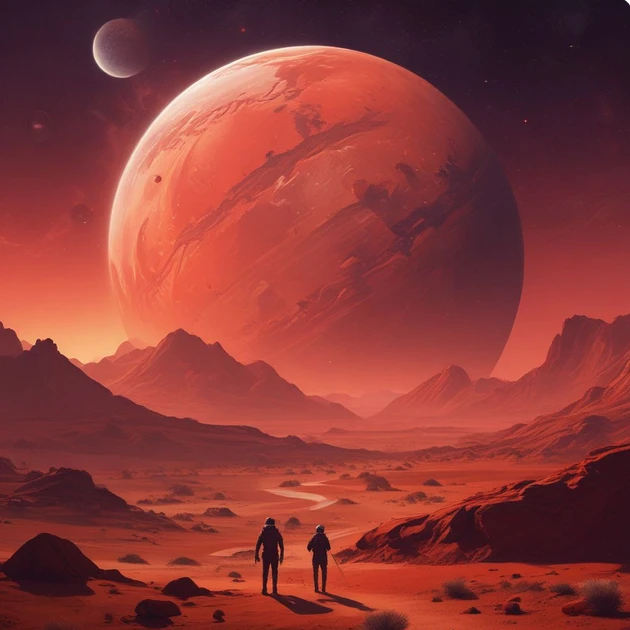

Before jumping straight to the answer, let’s play a quick mental game.
Quick Hint Before the Answer
Imagine looking up at the night sky and spotting a planet that shines with a reddish glow — not bright like a star, but clearly different from everything around it. Ancient civilizations noticed it too, and they all gave it a special meaning.
So, which planet could that be?
Which Planet Is Called the Red Planet?
The planet known as the Red Planet is Mars.
That’s the short answer. But the reason behind this nickname — and what makes Mars so fascinating — is where things get interesting.
Why Is Mars Called the Red Planet?
The name comes from its distinct color. Mars appears red when seen from Earth, and this is not just an illusion.
The Science Behind the Red Color
Mars looks red because its surface is covered with iron oxide — basically, rust.
- The same chemical process that turns metal rusty on Earth
- Fine dust spreads across the planet’s surface
- Sunlight reflects off this dust, creating that red appearance
So in a way, Mars is a giant rusty world floating in space.
Where Is Mars Located in the Solar System?
Mars is the fourth planet from the Sun, sitting right after Earth.
Its Position Matters
- Closer to the Sun than Jupiter
- Farther from the Sun than Earth
- Part of the inner rocky planets
This location makes Mars one of Earth’s closest planetary neighbors, which is why scientists are so interested in it.
What Makes Mars So Special?
Mars is not just famous for its color. It has features that make it one of the most studied planets in space.
Unique Characteristics of Mars
- Home to Olympus Mons, the largest volcano in the solar system
- Contains Valles Marineris, a massive canyon system
- Has polar ice caps made of water and carbon dioxide
- Experiences dust storms that can cover the entire planet
Mars is cold, dry, and harsh — but also full of scientific mystery.
A Tiny Knowledge Check
Let’s test what you’ve picked up so far.
Mini Quiz
Why does Mars appear red?
A) Because of lava on its surface
B) Because of iron oxide (rust)
C) Because it reflects sunlight differently than other planets
Correct answer: B
If you got that right, you’re already thinking like a space nerd.
Can Humans Live on Mars?
One of the most searched questions today is “can humans live on Mars?”
The Reality
Right now, living on Mars is not possible without advanced technology because:
- There is almost no breathable oxygen
- Temperatures are extremely low
- Radiation levels are dangerous
- Liquid water is very limited
However, space agencies and companies like NASA are actively studying the possibility of future human missions.
Interesting and Fun Facts About Mars
Mars might look quiet from far away, but it has plenty of surprises.
Things You Might Not Know
- A day on Mars is very similar to Earth — about 24.6 hours
- Mars has two small moons: Phobos and Deimos
- Gravity on Mars is about 38% of Earth’s gravity
- Scientists have found evidence of ancient water flows
- Sunsets on Mars appear blue, not red
And here’s something interesting: if you could stand on Mars, you might feel lighter — but definitely not warmer.
Why Mars Still Captures Our Imagination
Mars has always stood out among the planets. Its color made ancient people associate it with war, while modern science sees it as a possible future destination.
Why It Matters Today
- It is the most explored planet after Earth
- It may hold clues about past life
- It is a target for future human exploration
- It helps scientists understand planetary evolution
Mars is not just another planet — it’s a place that keeps raising questions we haven’t fully answered yet.